What “pre-preg” means—and why it matters
Most people know carbon is strong and light. Fewer know that how it’s made changes everything.
Pre-preg carbon arrives already infused with the exact resin content, manufactured under controlled conditions. During cure, it consolidates into a uniform, high-strength laminate with minimal voids.
This is the same technology used in Formula 1 cars and America’s Cup yachts—where every gram of weight and every fraction of strength can decide the outcome. Applied to ocean rowing, it delivers a structure that’s lighter at the same strength—and stronger at the same weight—than conventional hand-laminated carbon. That translates directly into more speed, more efficiency, and more safety when the sea turns rough.
The build partners behind the boats
Paul Dijkstra Composites (PDC): pre-preg craftsmanship
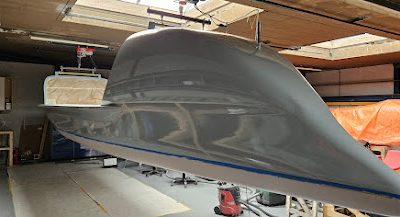
Our carbon hulls are produced by Paul Dijkstra Composites, specialists in advanced composite structures. Using pre-preg carbon and autoclave curing, PDC delivers hulls with aerospace-grade consistency and the reliability ocean rowing demands. Their pedigree includes ocean-going craft that have proven themselves at the highest level of endurance racing.
Curve Works: thermoformed core kits for lighter, faster builds
For the inner structure we work with Curve Works, who supply 3D thermoformed core kits. These cores are shaped on adaptive, reconfigurable moulds so they fit perfectly into the laminate. This reduces waste, speeds up assembly, and ensures the carbon layers bond seamlessly to the core—saving weight without sacrificing strength.
Gurit® Corecell™ M: engineered for the ocean
At the heart of our sandwich structures lies Gurit® Corecell™ M, a structural foam designed for the harshest marine conditions. Engineered to handle repeated slamming loads and high-temperature pre-preg curing, Corecell provides stiffness and durability mile after mile. It’s a material already validated in some of the toughest ocean races in the world.
How it comes together
-
Precision layup – Pre-preg carbon plies are cut and placed to match our laminate schedule, tuned for ocean loads.
-
Core integration – Thermoformed core sections drop into place with perfect fit, ensuring consistent bonding.
-
Autoclave cure – Under heat and pressure, the laminate consolidates to aerospace standards, eliminating voids and imperfections.
Why you feel the difference at sea
Because pre-preg carbon is lighter, every stroke translates more directly into speed. With less mass to move, crews can maintain a higher average pace for the same effort, saving precious energy on long crossings.
The stiffer, more consistent structure means the boat holds its lines even in confused seas, resisting the fatigue and flex that can slow a hull over thousands of miles. Rowers feel the difference as a steadier rhythm, a platform they can trust in every condition.
A cleaner, near-flawless finish reduces weak spots and hidden defects. When the ocean turns rough, that means fewer surprises and greater confidence in the integrity of the hull.
And because pre-preg allows for repeatable build quality, every boat comes off the mould with the same high-performance baseline. Crews no longer play the lottery of a “light” or “heavy” boat — they know exactly what they’re getting: a design built to perform as intended.
Proof, not promises
Every component choice we make—pre-preg carbon, thermoformed cores, high-performance foam—is validated in real ocean racing. These aren’t experimental ideas; they are proven technologies drawn from Formula 1, professional yacht racing, and aerospace engineering—applied with one goal: to make boats lighter, stronger, and faster.
Ready to build your advantage?
If you’re planning a crossing—or simply want a safer, faster, more reliable ocean boat—pre-preg carbon and advanced composite engineering give you the edge.
Talk to us about the D-Series and discover how we can build the right boat for your expedition.
Row Beyond Limits.